
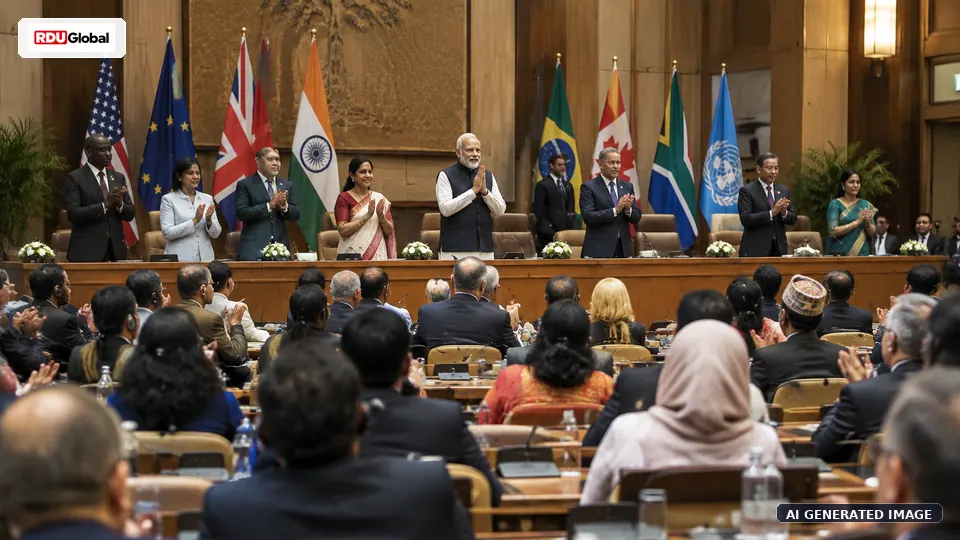
Speaking at the closing session of the 12th BRICS Parliamentary Forum, Lok Sabha Speaker Om Birla delivered a forceful appeal for stronger inter-parliamentary cooperation among BRICS nations, presenting legislatures as central to building trust, advancing development, and giving democratic legitimacy to international cooperation. His intervention came at a time when the grouping is seeking to broaden its relevance beyond high-level diplomacy and into the institutional work of lawmaking, oversight, and public accountability.
Parliamentary Diplomacy
Birla's address placed unusual emphasis on the role of elected institutions in shaping the future of BRICS cooperation. Rather than treating the forum as a ceremonial gathering, he described it as a platform where lawmakers can exchange experience on governance, social inclusion, economic resilience, and institutional reform. The message was clear: if BRICS is to remain relevant as a global forum, its parliamentary dimension must become more substantive and more regular.
That framing reflects a broader Indian diplomatic instinct. New Delhi has increasingly sought to project parliamentary engagement as a complement to executive-level diplomacy, especially in multilateral settings where shared political values and development priorities can be translated into practical cooperation. Birla's remarks aligned with that approach, suggesting that legislatures can help bridge national priorities with collective action on issues such as development financing, digital transformation, and social welfare.
Development And Inclusion
A central theme of the speech was inclusive development. Birla highlighted the need for growth models that are not only fast but also equitable, resilient, and responsive to citizens' needs. In the BRICS context, this is significant because the grouping brings together economies with diverse political systems, income levels, and development trajectories. Parliamentary dialogue, he argued, can help identify common ground on policies that expand opportunity while protecting democratic accountability.
The emphasis on inclusion also carries domestic resonance for India, where parliamentary institutions are expected to mediate between rapid economic change and the demands of a large, diverse population. By linking BRICS cooperation to social welfare and citizen-centric governance, Birla positioned the forum as more than a geopolitical platform. He cast it as a venue where lawmakers can exchange lessons on how to make development more durable and politically legitimate.
India's Multilateral Signal
The address also served as a signal of India's broader multilateral posture. At a time of intensifying global fragmentation, India has consistently argued for a more representative and balanced international order. Parliamentary diplomacy offers a lower-friction channel for advancing that argument, particularly when formal summit diplomacy is constrained by strategic differences among member states.
Birla's intervention suggested that the BRICS parliamentary track can help sustain dialogue even when broader international politics are strained. By encouraging lawmakers to engage directly, India is effectively promoting a model of cooperation that is less dependent on headline agreements and more rooted in institutional continuity. That approach may prove especially valuable as BRICS expands its profile and seeks to demonstrate that it can deliver tangible outcomes beyond rhetoric.
The closing session therefore carried more than procedural significance. It highlighted how India views parliamentary forums as tools of statecraft, capable of reinforcing democratic legitimacy while supporting economic and diplomatic objectives. Birla's remarks were not simply a ceremonial conclusion to a multilateral meeting; they were a statement of intent about how India wants BRICS to evolve.
For New Delhi, the message is strategically consistent. In a world marked by uncertainty, legislative institutions can provide continuity, scrutiny, and public confidence. By elevating the role of parliaments within BRICS, Birla underscored a broader Indian belief that durable international cooperation must be anchored not only in governments, but in representative institutions that can translate agreements into accountable action.