
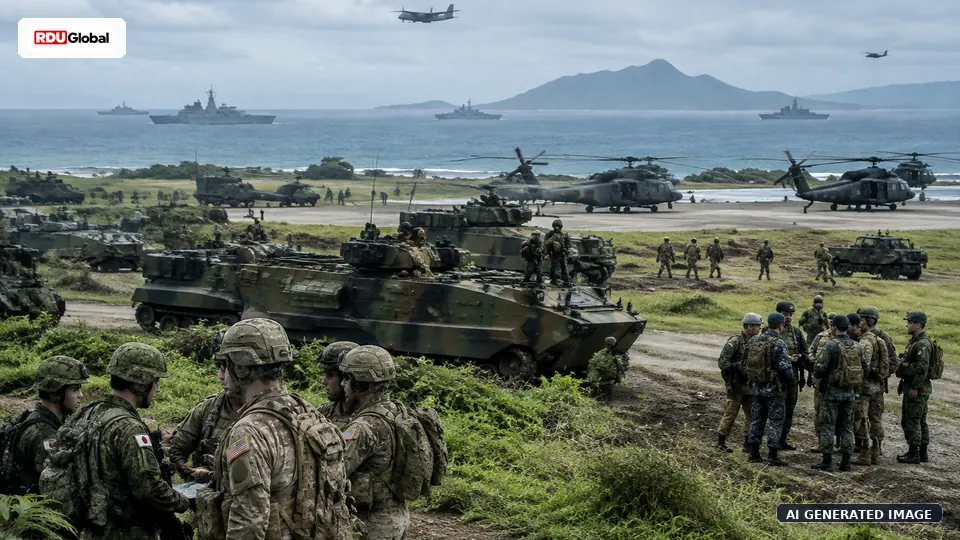
Japan has launched Exercise Keen Sword 2027 on Ishigaki Island, opening one of the most expansive bilateral and multinational military drills in the region this year and signaling a continued push by Tokyo and Washington to sharpen readiness across the southwestern island chain. The exercise involves about 45,000 Japan Self-Defense Forces personnel and 11,000 U.S. service members, alongside forces from Australia, Canada, France, Germany, the Netherlands, New Zealand and the Philippines.
Island Chain Focus
The choice of Ishigaki is strategically significant. The island sits within Japan's southwestern frontier, an area that has become central to Tokyo's defense planning because of its proximity to key maritime routes and contested waters in the East China Sea. By staging a major exercise there, Japan is not only testing command-and-control and logistics in a geographically sensitive environment, but also demonstrating its ability to reinforce remote islands under pressure.
Keen Sword has long served as a key venue for Japan and the United States to rehearse joint operations, but the scale and multinational character of the 2027 iteration reflect a broader shift. The exercise is no longer just about bilateral coordination. It is increasingly a platform for integrating partner forces into a shared operational framework, with a focus on rapid deployment, island defense, maritime security and cross-domain coordination.
Allied Interoperability
The participation of Australia, Canada, France, Germany, the Netherlands, New Zealand and the Philippines adds political and military weight to the drill. Their presence suggests a widening network of security cooperation that extends beyond the traditional U.S.-Japan alliance and into a more distributed coalition of like-minded states. For many of these countries, participation in Japan is also a practical way to improve interoperability in the Indo-Pacific, where future contingencies could demand faster coordination across air, sea, land, cyber and logistics domains.
The exercise comes at a time when regional militaries are placing greater emphasis on dispersed operations, resilient supply lines and the ability to sustain forces across island terrain. That is especially relevant for Japan, whose defense posture has increasingly focused on the Nansei island chain, where distance, geography and limited infrastructure complicate reinforcement and resupply. Large-scale drills such as Keen Sword are designed to identify those bottlenecks before a crisis exposes them.
For the United States, the exercise reinforces its forward posture in the Indo-Pacific and its commitment to working with allies on contingency planning. The presence of U.S. forces in such numbers also highlights the continuing importance of Japan as a hub for regional deterrence and operational access. In practical terms, these drills help refine how allied units communicate, move equipment, share intelligence and coordinate command decisions under realistic conditions.
Strategic Signaling
Beyond the military training value, Keen Sword 2027 carries clear strategic signaling. Multinational exercises of this scale are intended to show that allied forces can assemble quickly, operate together and sustain a credible response in the face of regional instability. They also send a message that security cooperation in the Indo-Pacific is becoming more connected and more routine, rather than ad hoc.
That message matters because the region's security environment has become more complex, with rising concern over maritime coercion, missile threats and the vulnerability of remote islands and sea lanes. Japan has responded by expanding its defense capabilities and deepening ties with partners that share an interest in preserving regional stability and freedom of navigation. Exercises like Keen Sword are one of the clearest expressions of that strategy.
The scale of the 2027 drill also suggests that allied militaries are preparing for a wider range of scenarios than in the past. While official details of the exercise will determine the exact training objectives, the overall structure points to a focus on joint readiness, reinforcement of remote territories and the ability to operate as a coalition under time pressure. In that sense, Keen Sword is both a training event and a strategic rehearsal for the security architecture the region may increasingly rely on.
As the exercise unfolds, attention will likely center on how effectively the participating forces integrate across national lines and how Japan uses the drill to validate its evolving defense posture. For now, the opening on Ishigaki Island marks a clear statement: the Indo-Pacific's leading militaries are investing heavily in preparedness, coordination and deterrence, and they are doing so in one of the region's most strategically sensitive locations.