
ixigo, one of India's leading mobile travel marketplaces, has announced partnerships with Uber and redBus to allow train travellers to book cabs and buses directly within its trains app. The integration is designed to reduce friction for passengers who typically move across multiple apps to complete a single journey, especially when connecting from stations to homes, hotels, workplaces or onward transport hubs.
The move is strategically significant because it pushes ixigo further into the high-frequency travel services layer, where convenience and repeat usage can matter as much as fare comparison. By embedding cab and bus bookings natively into the trains experience, the company is positioning itself not merely as a rail search and booking platform, but as a broader trip orchestration layer for Indian travellers. In a market where consumer attention is fragmented and acquisition costs remain high, such integration can strengthen retention and increase the number of transactions per user.
Trip Flow Integration
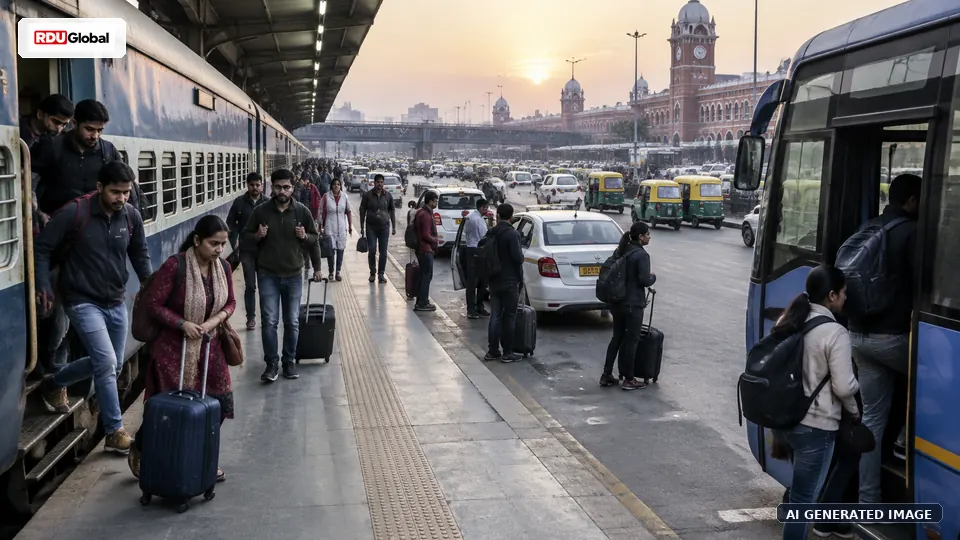
The new functionality is aimed at train passengers who often need immediate ground transport after arriving at a station or require a bus connection to complete the journey. Rather than redirecting users to separate apps or websites, ixigo is attempting to keep the booking flow inside its own interface. That approach can improve conversion rates by reducing drop-offs at the point where travellers typically encounter the most friction.
For Uber, the partnership offers access to a large and intent-rich audience of rail passengers at the exact moment they need a ride. For redBus, the integration creates a pathway into intercity and feeder travel demand that originates from train bookings. The arrangement reflects a broader trend in Indian travel tech: platforms are increasingly bundling mobility services to capture more of the travel wallet and reduce dependence on a single product line.
The timing also matters. India's travel market has become more competitive as digital adoption deepens and consumers increasingly expect end-to-end planning tools rather than isolated booking utilities. Rail remains one of the country's most important transport modes, and any platform that can simplify the surrounding logistics stands to gain an advantage in user loyalty and frequency of engagement.
Platform Economics
From a business perspective, the partnerships may help ixigo improve monetisation without relying solely on train ticketing margins. Travel marketplaces often face pressure from price-sensitive consumers and regulatory constraints, making ancillary services an important source of revenue and margin expansion. Cabs and buses are natural adjacencies because they are closely linked to the core rail use case and can be cross-sold at moments of high intent.
The integration also signals a shift in how travel apps are being built in India. Instead of treating transport categories as separate silos, companies are increasingly stitching them together into a single journey experience. That can create stronger network effects: the more services a user can access in one place, the more likely they are to return to that platform for future trips.
For investors watching India's consumer internet and mobility sectors, the development is another example of how established digital brands are trying to deepen engagement rather than simply chase new downloads. In a crowded market, product breadth and convenience can be as important as brand recognition. Partnerships with recognised names such as Uber and redBus also lend credibility to the proposition and may help ixigo reinforce its position in the travel stack.
Competitive Stakes
The broader competitive implication is clear: travel platforms are moving toward super-app style utility, but through focused, category-specific entry points rather than broad consumer bundles. ixigo's trains app is a logical place to introduce these services because rail passengers often face predictable first-mile and last-mile needs. If the integration proves smooth and widely adopted, it could become a template for further service layering across the company's ecosystem.
The announcement also highlights how Indian travel companies are responding to changing consumer expectations. Travellers increasingly want speed, certainty and fewer handoffs between booking stages. Platforms that can compress those steps may be better placed to win repeat business, especially among mobile-first users who expect transactions to be completed in a few taps.
While the partnerships do not fundamentally alter the structure of India's travel market, they do sharpen the competitive edge around convenience. For ixigo, the immediate test will be whether the new in-app options translate into higher engagement, stronger conversion and more frequent use of its trains product. For Uber and redBus, the benefit lies in being embedded at a high-intent moment in the travel journey, where demand is immediate and practical rather than speculative.