
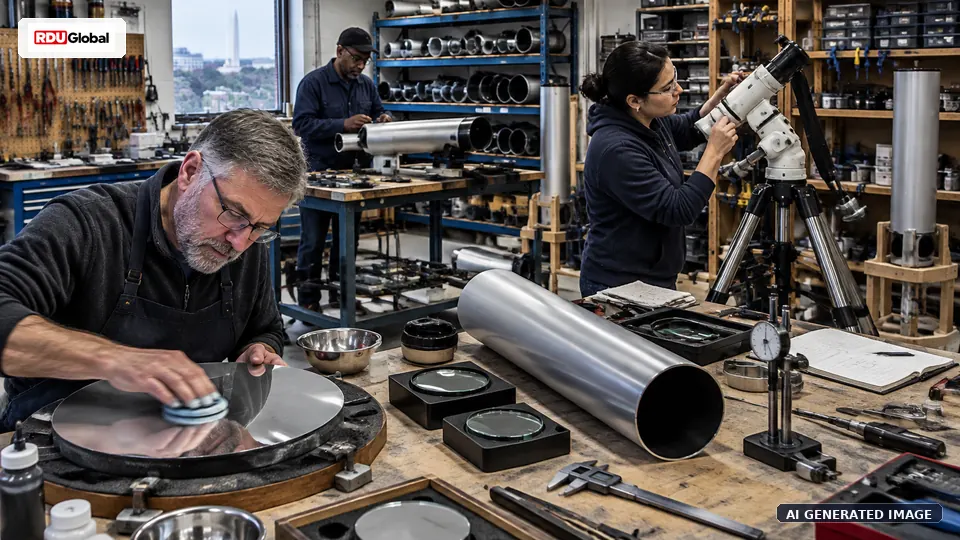
The appeal of building a telescope from scratch is not nostalgia alone. It is a deliberate rejection of disposability in favor of precision, durability and understanding. In workshops, garages and club basements, amateur telescope makers spend months grinding mirrors, aligning optics and calibrating mounts to create instruments that can reveal the night sky with remarkable clarity. The practice is old, exacting and increasingly resonant in a world grappling with climate anxiety, supply-chain fragility and a wider search for low-waste, high-value craftsmanship.
Craft Over Convenience
For many participants, the process is as important as the finished instrument. A telescope assembled from purchased parts can be impressive, but one built from raw materials carries a different meaning: the maker has learned how light is gathered, focused and magnified, and has confronted the physical realities of precision. That knowledge turns astronomy from passive consumption into active inquiry. It also reflects a broader cultural shift toward repair, reuse and self-reliance, values that have gained traction as consumers and institutions reassess the environmental cost of constant replacement.
The telescope-making community is small, but its ethos is expansive. It prizes patience over speed, skill over branding and function over spectacle. In an age when even sophisticated consumer electronics are often sealed, opaque and difficult to repair, the telescope stands out as a device that can still be understood from the inside out. That transparency has educational value. Students, hobbyists and retirees alike can see how a mirror blank becomes an optical instrument, and in the process they absorb lessons in geometry, materials science and mechanical design.
Science In Public Hands
The relevance of this craft extends beyond hobby culture. Amateur-built telescopes have long played a role in democratizing access to the sky, allowing people without institutional budgets to participate in observation and discovery. That matters at a time when public trust in science is uneven and when climate and environmental debates often hinge on whether people feel connected to evidence, measurement and long-term observation.
There is also a quiet climate dimension to the story. Building rather than buying can reduce waste, extend product life and encourage a more circular relationship with materials. The telescope makers' ethic is not a climate policy, but it is aligned with the broader transition away from throwaway consumption. Their work suggests that technical ambition and environmental restraint are not opposites. A carefully made object can be both elegant and economical in its use of resources.
The craft also preserves a form of manual literacy that is increasingly rare. Grinding a mirror to the correct curvature or tuning a mount for stability requires repeated measurement, correction and judgment. Mistakes are visible and instructive. Success cannot be outsourced to software alone. That makes telescope making unusually relevant in a period when many sectors are trying to rebuild domestic manufacturing capacity and cultivate technical skills that can support a cleaner, more resilient economy.
A Durable Future
What makes the story compelling is not simply that people still build telescopes by hand. It is that they do so with a seriousness that feels almost countercultural. Their workshops are laboratories of attention, where the reward is not only a clearer view of Saturn's rings or a distant nebula, but a deeper relationship with the material world. In that sense, the craft is a small but telling example of how climate-era values are reshaping what people admire: not just scale and speed, but longevity, repairability and competence.
As the global economy confronts the costs of extraction, waste and overconsumption, the telescope makers offer a modest but meaningful counterpoint. They remind us that some of the most advanced tools are not necessarily the most automated. Sometimes the most modern act is to make something carefully, by hand, and keep it working for decades.